The Algorithm Whisperers: Inside the Communities Reading Glitches Like Omens

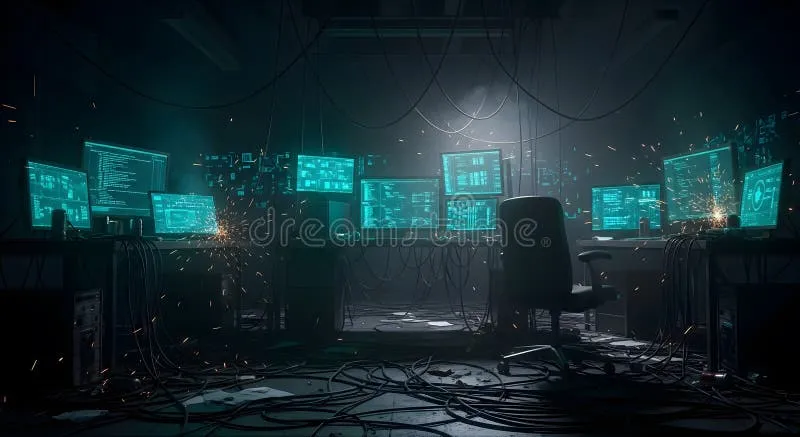
Photo: glowing computer screen data streams abstract digital noise, via thumbs.dreamstime.com
Somewhere in a Discord server with a name that looks like a corrupted file path, a user posts a screenshot. It's a YouTube recommendation sidebar — mundane on its surface, the kind of thing most people scroll past without registering. But this one has a particular quality. The videos recommended, taken together, seem to spell something out. A sequence. A message. The thread that follows runs to several hundred replies.
This is the world of glitch divination, and it is stranger and more populated than you probably expect.
Omens in the Output
The practice — if you can call it that — doesn't have a single agreed-upon name. Participants across different communities use varying terminology: "signal reading," "algo-scrying," "error augury." What they share is a fundamental premise: that the misfires, unexpected outputs, and apparent errors produced by algorithmic systems are not random noise, but legible data carrying some form of meaning.
This ranges from the relatively mild — noticing that a Spotify playlist generated "by accident" seems eerily appropriate to a current emotional state — to the more elaborate, where communities collaboratively interpret complex sequences of software behavior as structured messages or predictive patterns.
"The algorithm knows things," says Marcus, a 28-year-old from Portland who moderates one of the larger communities dedicated to this practice. "I don't mean it's conscious. I mean it's processing so much input that its errors reflect real patterns in the world. The glitch is where the mask slips."
Marcus has been at this for about four years. He got into it after a recommendation engine surfaced a song he hadn't heard since childhood — a song that was, he says, playing on the radio the morning his father died. The timing felt impossible. He started paying closer attention.
Ancient Practice, New Interface
Human beings have been reading meaning into noise for as long as there have been human beings. Augury — the Roman practice of interpreting bird flight patterns — was institutionalized state policy. Tasseography reads tea leaves. Cleromancy casts lots. Pareidolia, the cognitive tendency to find faces and forms in random visual data, is so deeply wired into human perception that researchers consider it a feature of normal brain function, not a glitch.
What's happening in these digital communities is, at minimum, a contemporary expression of something very old: the impulse to find signal in chaos, to impose narrative on entropy.
"The tools change, the practice doesn't," observes Dr. Tanya Whitfield, a cognitive psychologist at a research university in the Midwest who has been studying online communities around pattern-seeking for the past several years. "People have always looked for meaning in systems they don't fully understand. The algorithm is genuinely opaque — even to its creators in many cases — which makes it a perfect canvas for this kind of projection."
Whitfield is careful not to be dismissive. "Projection isn't necessarily wrong," she adds. "Pattern recognition is how we navigate the world. The question is always about calibration — when does useful pattern recognition become noise-chasing?"
The Taxonomy of Glitch Reading
Spend enough time in these spaces and you start to notice distinct schools of thought. There are the strict empiricists — people who document glitches obsessively, building databases of anomalous recommendations and cross-referencing them with real-world events, trying to build something like a predictive model. Their threads look like research papers, full of screenshots, timestamps, and methodological arguments.
Then there are the more intuitive practitioners, who treat the process less like analysis and more like meditation. For them, the specific content of a glitch matters less than the act of paying close attention to the unexpected. A recommendation engine error becomes an invitation to notice something they might otherwise have scrolled past.
And then there's a third group that occupies weirder territory — people who have developed elaborate interpretive frameworks, sometimes drawing on numerology, Jungian synchronicity theory, or systems derived from older esoteric traditions. They've essentially built new divination practices from scratch, using algorithmic errors as their primary medium.
"I use the I Ching as a reference point," explains Sasha, a 34-year-old graphic designer in Austin who goes by a handle that translates roughly to "signal loss." "Not literally, but structurally. The I Ching works by introducing controlled randomness and then reading it carefully. That's basically what I do with recommendation errors. The algorithm introduces noise. I read it."
The Synchronicity Question
Carl Jung's concept of synchronicity — meaningful coincidence, acausal connection between events — comes up constantly in these communities. Jung proposed that events could be meaningfully related without being causally connected, that the psyche and the external world sometimes rhyme in ways that exceed probability without requiring supernatural explanation.
Whether or not you buy Jung, the framework maps interestingly onto the algorithmic context. Recommendation systems are, after all, trained on collective human behavior. When they misfire, they're misfiring on the basis of patterns drawn from millions of people's choices, fears, and desires. The errors aren't purely random — they're distorted reflections of human patterns, processed through systems we don't fully understand.
"There's something genuinely interesting in that," Whitfield concedes. "These systems aren't random number generators. Their errors have structure, even if that structure isn't intentional. Whether that structure carries meaning is a philosophical question, not just a psychological one."
Marcus puts it differently. "I'm not saying the algorithm is God. I'm saying it's a mirror with a weird angle. Sometimes the distortion shows you something the straight reflection doesn't."
The Aesthetic of Error
What strikes an outside observer about the more artistically inclined corners of this subculture is how beautiful the practice can look. Screenshots curated for their visual strangeness. Glitch sequences assembled into something resembling poetry. Error messages recontextualized as koans.
There's a genuine aesthetic sensibility at work here, one that overlaps with the broader glitch art movement while pointing somewhere more personal and stranger. These aren't just images of broken systems — they're broken systems treated as texts, read closely, argued over, interpreted.
Sasha has started printing her most significant glitch captures and framing them. One hangs above her desk: a streaming service's autoplay function that cycled through seven unrelated videos in sequence, each one corresponding, she believes, to a phase of a relationship she was ending at the time. "It's not proof of anything," she says. "It's a record of a moment when the noise made sense."
That distinction — between proof and record, between prophecy and resonance — might be the most honest thing anyone in this space has said. The glitch prophets aren't necessarily claiming certainty. They're claiming attention. In a media environment engineered to keep you passive and scrolling, there's something almost rebellious about treating the machine's errors as worthy of careful, serious reading.
The algorithm misfired. Somebody was watching. They wrote it down.