Dead Air Dispatch: The Strange World of Radio Broadcasts Nobody Can Explain
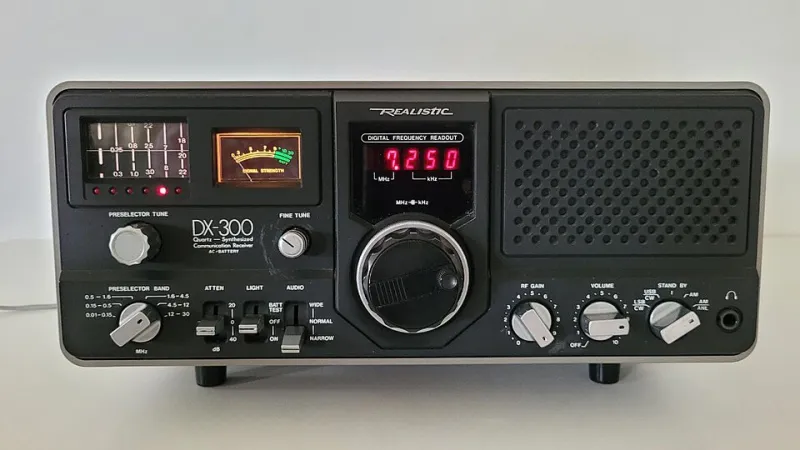
Photo: Meineemailadresse, CC BY-SA 4.0, via Wikimedia Commons
If you own a shortwave radio or a software-defined radio dongle — the cheap USB kind that turns your laptop into a signal scanner — you've probably already gone looking for something strange. Maybe you found it. The radio spectrum, it turns out, is louder than most people expect, and not all of that noise comes with an explanation attached.
For years, a loose network of amateur signal hunters, cryptography hobbyists, and deeply online investigators has been cataloguing a specific category of transmission: broadcasts that appear on obscure frequencies, often encrypted or structured in ways that resist conventional decoding, and that nobody — not the FCC, not academic researchers, not the ham radio community — has been able to definitively identify. Some of these signals have been active for years. A few have been active for decades.
This is a story about what we know, what we don't, and why the gap between those two things has become a genuine cultural phenomenon.
What We're Actually Talking About
First, some scope. The radio mystery space is wide and contains multitudes — some of it well-documented, some of it speculative, and some of it actively misrepresented in the corners of the internet where these topics tend to circulate.
On the well-documented end, "numbers stations" have been a known phenomenon since at least World War II. These are shortwave broadcasts that transmit sequences of numbers, letters, or tones — widely understood to be intelligence agency communications sent to field operatives using one-time pad encryption. The Conet Project, a four-disc compilation of numbers station recordings released in 1997, brought these into broader cultural awareness. They're real, their general purpose is understood, and their existence has been officially acknowledged, if not confirmed in detail, by governments including the UK and Cuba.
But there's a second category that's harder to slot. These are transmissions that don't fit the numbers station model — signals with unusual encoding schemes, broadcasts that appear on frequencies typically associated with specific licensed uses, transmissions that seem to originate from locations that shift or can't be triangulated. The online communities tracking these, spread across forums like Reddit's r/signalidentification and the Signal Identification Wiki, have catalogued dozens of them.
The Buzzer and Its Cousins
The most famous example in this second category is UVB-76, a Russian shortwave station that has been broadcasting a monotonous buzzing tone — interrupted occasionally by voice messages in Russian — since at least the 1970s. Its purpose has never been officially confirmed. Theories range from military communication trigger to ionospheric research to a deadman switch for some kind of automated system. The station is real, documentable, and completely unexplained at the official level.
UVB-76 has inspired a dedicated international following. There are live stream feeds of the broadcast. There are Discord servers where listeners gather to share recordings of voice messages and attempt to decode their significance. When a new voice message appears — which happens infrequently and unpredictably — it tends to generate immediate attention across multiple communities simultaneously.
"It's not really about decoding it at this point," says one long-time listener who participates in a US-based signal monitoring group and asked to be identified only by their callsign, KD9VXT. "It's become something else. It's about the act of listening. The fact that it's there and we don't know why is the whole thing."
This is a sentiment that comes up repeatedly in these communities, and it points to something interesting about what's actually happening culturally around unexplained signals.
The Allure of the Undecoded
The internet has made it significantly easier to find, record, and share unusual radio transmissions. Software-defined radio hardware that costs under $30 can receive signals across a huge frequency range. Free software like SDR# or GQRX lets you visualize the spectrum in real time, making anomalies visible in ways that would have required expensive equipment a generation ago.
The democratization of signal monitoring has produced a genuine investigative community — people with real technical skills who approach unexplained broadcasts with rigor and skepticism. The Signal Identification Wiki, a community-maintained database, documents hundreds of known signal types with audio samples and technical analysis. When an unknown signal gets posted to r/signalidentification, it often gets identified within hours by someone who recognizes the encoding scheme.
But the signals that don't get identified — the ones that linger in the database as question marks — accumulate a different kind of cultural weight. They become focal points for speculation, community, and something that functions almost like folk mythology.
"There's a specific kind of person who gets drawn to this," says Dr. Margot Ellison, a communications researcher at a Midwest university who has studied online communities organized around unexplained phenomena. "They're not credulous, necessarily. A lot of them are engineers, IT people, ham radio operators with real expertise. What they share is a tolerance for ambiguity and an interest in the edges of systems — in finding the places where official explanations run out."
Skepticism as a Practice
It's worth being direct about the limits of what any of this means. The existence of unexplained signals does not imply the existence of anything sinister, extraterrestrial, or conspiratorial. The most likely explanations for most unidentified broadcasts are mundane: military communications using proprietary encoding, experimental research transmissions, propagation anomalies that make distant licensed signals appear where they shouldn't, or equipment malfunctions generating spurious emissions.
The communities doing this work, to their credit, tend to know this. The better signal hunting forums actively push back against sensationalism, insisting on documented evidence and technical rigor before entertaining exotic explanations.
What makes the unexplained-signals space genuinely interesting isn't the possibility of hidden meaning. It's the texture of the mystery itself — the fact that the radio spectrum, a regulated and extensively mapped domain, still contains signals that nobody has officially claimed. In an era when most questions can be answered with a search, that's a specific kind of strangeness worth paying attention to.
The frequency is open. The broadcast is running. Nobody's talking.
For now, that's enough.