Error State: The Artists Who Turned Broken Video Into a Language
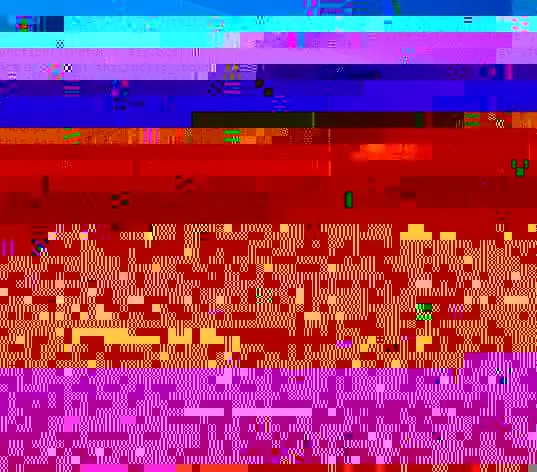
Photo: The People's Internet, CC0, via Wikimedia Commons
There's a specific kind of panic that hits when a video file refuses to open right. The frozen frame. The smeared geometry where a face should be. Colors bleeding sideways like a wound. For most people, that's a cue to redownload the file, curse their internet connection, and move on. For a loose, thriving underground of experimental artists scattered across the US and beyond, that moment of failure is exactly where the work begins.
Glitch art — the deliberate manipulation of corrupted media — has been hovering at the edges of digital culture for decades, but something has shifted. What was once a niche curiosity traded between coders and experimental filmmakers on obscure forums has started bleeding into gallery spaces, album covers, and short-form video feeds. The aesthetic has a pulse now. And the people making it are getting philosophical about why.
The Codec Is the Canvas
To understand what these artists are doing, you need a rough sense of how video files actually work. Modern codecs — the compression algorithms that make video files manageable — operate by storing only the differences between frames rather than each frame in full. When that data gets corrupted, the codec starts guessing. It fills gaps with whatever information it has available, which is often wrong in deeply strange ways. Faces stretch. Backgrounds replicate in tile patterns. Motion trails ghost across static objects.
Artists working in this space call the process "databending" or "datamoshing," depending on the specific technique. Datamoshing, in particular, involves surgically removing or duplicating specific frame data so that the codec applies motion information from one scene onto the static imagery of another. The result is footage that looks like it's melting from the inside — a quality that has shown up in music videos for artists ranging from Kanye West to experimental electronic acts with audiences of a few hundred dedicated followers on Bandcamp.
"The codec is doing exactly what it was built to do," explains one Brooklyn-based video artist who goes by the handle Vex_Null and has been working in corrupted media for about eight years. "It's not broken. It's working perfectly with broken information. That distinction matters to me. I'm not breaking the machine — I'm feeding it something it wasn't designed to survive."
From Hiding Errors to Celebrating Them
The philosophical shift at the center of glitch art is worth sitting with for a second. The entire history of consumer technology has been oriented toward making errors invisible. Error correction, redundancy, seamless playback — billions of dollars of engineering exist specifically so that you never have to see what Vex_Null and artists like them are deliberately engineering into their work.
That inversion carries weight. There's something almost confrontational about it. In a media environment obsessed with polish — 4K resolution, HDR, lossless audio — choosing to work in corruption reads as a statement. Not a nihilistic one, necessarily, but a skeptical one. A question about what we've agreed to call quality, and who benefits from that agreement.
Chicago-based multimedia artist Dara Osei, who incorporates datamoshed video into large-scale installation work, puts it more bluntly: "Clean imagery carries authority. We're trained to trust what looks produced. Glitch interrupts that trust. It reminds you that what you're watching was constructed — that there are seams underneath all of it."
Osei's installations have shown at experimental spaces in Chicago and Detroit, often pairing corrupted video loops with ambient sound design that emphasizes the mechanical origins of the imagery — hard drive hum, codec artifacts rendered as audio. The effect is disorienting in a way that feels intentional rather than accidental, which is precisely the point.
The Toolkit
For the uninitiated, the methods glitch artists use range from surprisingly accessible to genuinely arcane. On the accessible end: opening a JPEG in a text editor and deleting random chunks of data before resaving. This is sometimes called "hex editing" when done with precision, though plenty of artists prefer the unpredictability of blind deletion. The results are immediately visible — blocks of color displaced, portions of the image replaced with noise.
On the more technical end, artists like Vex_Null use custom scripts to manipulate video at the bitstream level, targeting specific frame types (I-frames versus P-frames, for those keeping score) to control exactly how the codec misinterprets the data. Some use software tools like Avisynth or FFmpeg with custom filters. Others have written their own tools entirely.
There's a whole ecosystem of tutorials, Discord servers, and GitHub repositories supporting this practice — a community infrastructure that's grown organically around a shared interest in making technology fail beautifully.
Static as Signal
What's striking about the glitch art community, when you spend time inside it, is how seriously its members take the conceptual underpinnings of the work. This isn't just aesthetic experimentation for its own sake. There are ongoing conversations about archival decay, about the ephemerality of digital media, about what it means to make art with tools that are actively trying to correct your intentions.
There's also a thread running through much of this work that connects it to older traditions of noise music, mail art, and Fluxus — artistic movements that also found meaning in interruption, in the accidental, in the gap between intention and outcome. Glitch art isn't working in isolation from art history. It's a specific chapter of a much longer argument about what counts as a mistake and what counts as a method.
"Every codec breakdown is a decision the machine made without you," Osei says. "My job is to listen to those decisions and figure out what they're saying."
The static, it turns out, has been trying to tell us something for a while. Some people are finally paying attention.