Read the Error: Meet the People Who Treat Your Computer's Crashes as Messages from Beyond
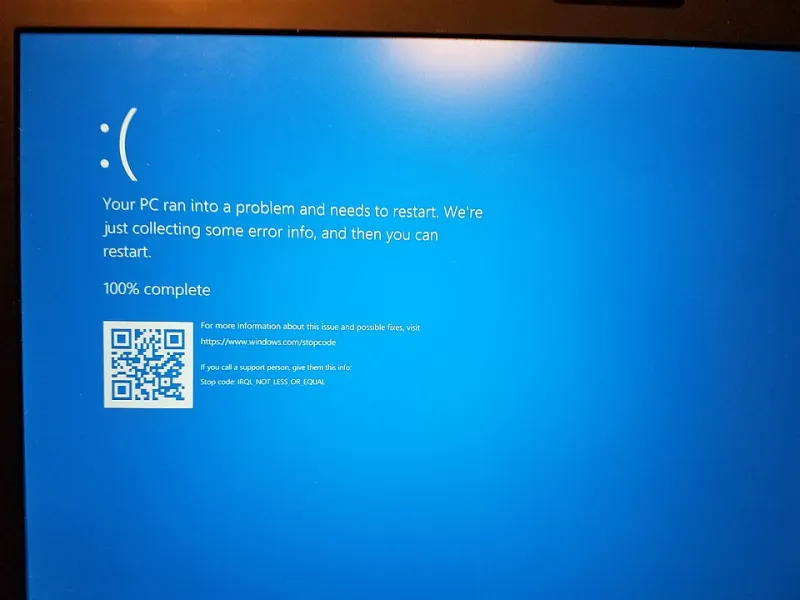
Photo: Oops4321, CC BY-SA 4.0, via Wikimedia Commons
The blue screen arrived on a Tuesday afternoon in March. Celeste, a 38-year-old graphic designer in Austin, Texas, had seen blue screens before — everyone has. But this one appeared at a specific moment: thirty seconds after she'd finished typing a question into her journal about whether to leave her job. The error code on screen was 0x000000F4. She wrote it down. Then she looked it up — not in a Microsoft support forum, but in a numerology reference guide.
F4, she tells me, reduces to a compound number with specific resonance in certain numerological systems. The timing felt deliberate. The crash felt like an answer.
"I know how that sounds," she says, with a laugh that suggests she's said it before. "I'm not delusional. I just think meaning is everywhere if you're paying attention, and I don't see why technology would be exempt from that."
Celeste is not alone. And the community she's part of is stranger, more organized, and more philosophically interesting than you might expect.
A Subculture Built in Broken Pixels
Scatter across Reddit threads, private Discord servers, and a handful of dedicated Substacks, there exists a loose but recognizable subculture of people who approach computer errors as interpretive events. They are not, by and large, technophobes. Many are developers, UX designers, IT professionals — people who understand exactly what a kernel panic is and why it happens, and who have nonetheless built a parallel interpretive framework for what it might mean.
The practices vary widely. Some practitioners work within established esoteric traditions — tarot readers who have developed card-to-error-code correspondences, numerologists who apply classical reduction techniques to hexadecimal values, astrologers who track whether crashes cluster around Mercury retrograde periods (spoiler: they believe they do). Others have developed entirely original systems, proprietary and idiosyncratic, built from personal experience and online community feedback.
What unites them is a rejection of pure mechanical causality as the only valid lens for interpreting technological events. A crash isn't just a driver conflict. A frozen screen isn't just a memory leak. It's also something that happened to you, at a specific moment, in a specific context — and that context might be worth examining.
The Tarot Angle
Among the most structured approaches is the one developed by a practitioner who goes by the online handle SeventhBit. She's been reading tarot for fifteen years and began integrating technology-specific symbolism around 2018, initially as a creative experiment that she says quickly started producing results she couldn't dismiss.
Her system maps common error categories to major arcana cards. Kernel panics correspond to The Tower — sudden structural collapse, unavoidable upheaval. Permission denied errors map to The Hierophant — institutional gatekeeping, questions of authority and access. The spinning loading wheel that never resolves is, in her framework, The Hanged Man: suspension, waiting, a period of forced stillness that asks you to reframe your perspective.
"I'm not claiming the computer is conscious," SeventhBit is careful to say. "I'm claiming that our relationship to these systems is deeply emotional and psychological, and that errors surface at moments of friction — which are often the same moments when we're most psychologically primed to receive information. The error becomes a mirror."
This is the more philosophically defensible version of the argument, and it's the one that tends to resonate with people who are skeptical of literal supernatural causation. You don't have to believe the universe is sending you messages through your MacBook. You just have to believe that moments of disruption create interpretive openings — and that the mind will find meaning if it's looking.
Pixel Artifacts and the Language of Corruption
Beyond error codes, a significant subset of the community focuses on visual glitches: pixel artifacts, color banding, screen tearing, the strange geometries that appear when video compression breaks down. These are treated less like text to be decoded and more like abstract imagery to be interpreted intuitively — closer to ink blot reading than numerology.
Devon, a 27-year-old from Chicago who works in video post-production, started photographing screen artifacts during a period of significant personal upheaval. "I was going through something hard, and my equipment kept glitching in ways that were unusual," he says. "I started documenting them. The images were genuinely beautiful. And looking at them, I kept seeing things — shapes, patterns, what felt like faces."
He's quick to acknowledge pareidolia — the brain's tendency to find familiar patterns in random visual data. But he frames that not as a debunking but as a description of the mechanism. "Pareidolia is how humans find meaning. It's not a bug in perception. It's a feature. The glitch gives the pattern-seeking mind something to work with."
Devon now runs a small online community where members share screenshots of visual glitches alongside their interpretations. The posts read like a hybrid of art criticism and dream journaling.
The Skeptic's Position (And Why It Doesn't Quite Land)
The obvious critique is confirmation bias: you notice the crashes that coincide with meaningful moments because you're primed to notice them, and forget the hundred crashes that happened at irrelevant times. The practitioners know this argument. They've all heard it. And most of them accept it as partially true while questioning whether it's fully disqualifying.
"Every interpretive system has confirmation bias baked in," SeventhBit points out. "Astrology, therapy, religion, financial analysis. The question isn't whether bias exists. It's whether the framework produces useful outputs for the person using it. Does it help people think? Does it open up reflection? Then it's doing something."
This is where the investigation gets genuinely murky. The glitch readers aren't making falsifiable empirical claims. They're making something closer to aesthetic and psychological ones — that a particular interpretive practice generates insight, regardless of whether the universe is literally encoding messages in your BSOD.
What the Machine Doesn't Know It's Saying
At its most interesting, this subculture is doing something that sits at the intersection of art, psychology, and digital culture criticism. It's pushing back, in a weird and personal way, against the idea that technology is a purely rational domain — that our machines are neutral tools operating outside the messy human context in which we use them.
Errors happen to people. They happen in moments. They interrupt things that matter. The glitch prophets are insisting that this is worth paying attention to — that the static in the signal might not be noise.
Whether or not you buy the metaphysics, it's a strange and human response to the increasingly alien environment we've built for ourselves. The machine crashes. You look for meaning. That impulse is as old as anything.