Tape Séance: The Believers Who Think Degraded VHS Is a Portal to Something Else
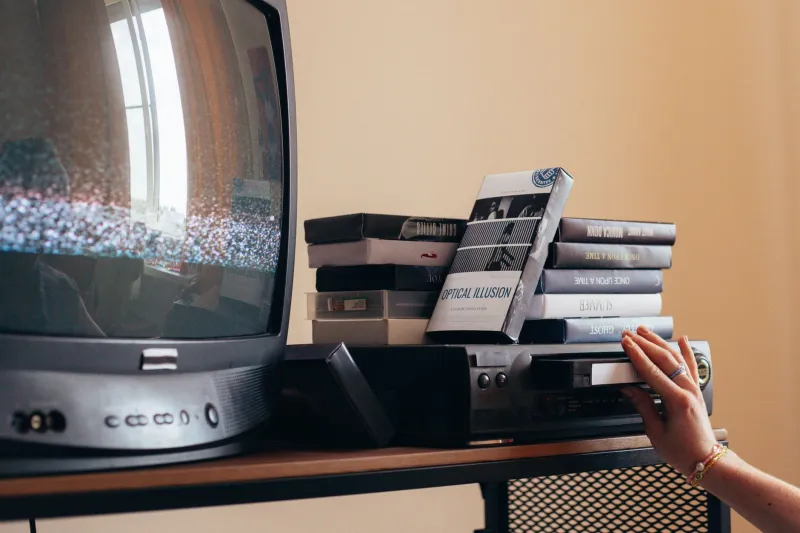
There's a particular kind of static that only VHS can produce. Not digital noise—not the clean pixel-burst of a corrupted file—but something warmer, more erratic. The picture folds in on itself. Colors bleed sideways. Faces melt at the edges and reconstitute wrong. It looks, to the right kind of eye, less like a technical failure and more like a message that got scrambled in transit.
For most people, a tape that looks like that goes in the trash. For a growing fringe of collectors, occultists, and media archaeologists scattered across forums and private Discord servers, that tape is exactly the one worth keeping.
The Rot Has a Name
They call it "tape drift," "ghost bleed," or sometimes just "the signal." The terminology varies by community, but the underlying conviction is consistent: certain VHS tapes, particularly those that have undergone significant magnetic degradation, exhibit visual and auditory anomalies that can't be fully explained by mechanical failure alone. Or so the theory goes.
The belief isn't new. It's been simmering in horror fan communities and paranormal hobbyist circles for at least two decades, quietly borrowing mythology from EVP research—the practice of recording audio in hopes of capturing spirit voices—and grafting it onto physical media. The logic, such as it is, runs something like this: analog magnetic tape stores information as physical impressions on a ferric surface. As that surface deteriorates, those impressions don't simply vanish. They layer. They bleed into each other. And in that layering, some people believe, something else occasionally surfaces.
What that "something else" is depends heavily on who you ask.
What People Claim to See
Spend enough time in the right corners of Reddit or Tumblr and you'll find threads cataloguing alleged anomalies. A tape recorded over multiple times that appears to show a figure not present in any of the original recordings. A home movie from the early '90s where a voice on the audio track says something that doesn't match the lips on screen—and doesn't match anything the family remembers saying. A rental copy of a mid-budget thriller that, in its degraded state, appears to contain an extra scene nobody can verify ever existed.
Most of these claims are unprovable by design. The tapes are often one-of-a-kind. The playback equipment is aging. The people making the claims are self-selecting into communities that reward exactly this kind of interpretation. But dismissing them wholesale misses something genuinely interesting about why these stories keep generating traction.
Nostalgia is part of it, obviously. VHS carries enormous emotional freight for anyone who grew up in the '80s and '90s. The format is inseparable from a specific texture of American childhood—Saturday morning cartoons, rented horror movies, family vacations preserved on camcorder tape. When that texture deteriorates, when the image corrupts, it doesn't just feel like data loss. It feels like memory loss. Like something personal is dissolving.
And when something personal dissolves, humans look for meaning in the residue.
The Folklore Pipeline
The mythology around haunted VHS didn't emerge from nowhere. It has clear lineage. The Ring and its Japanese predecessor Ringu popularized the idea of a tape as a cursed object—a vessel for something malevolent—and lodged it deep in collective cultural memory. Creepypasta traditions, particularly stories like "Candle Cove" and the various "lost episode" narratives, extended that framework into a sprawling folk genre where broadcast media becomes a conduit for the uncanny.
What's happening now feels like the next evolution of that tradition. Except the people involved aren't writing fiction. Or at least, they don't think they are.
"I'm not saying it's ghosts," one collector—who goes by the handle Ferric_Hymn on several forums—explained in a post that's been screenshot and shared widely. "I'm saying the tape is a record of electromagnetic events, and electromagnetic events don't stop when you stop recording. The tape keeps accumulating. It keeps picking things up. What you see in the static isn't nothing. It's everything the tape has been near."
That framing—scientific-sounding but untethered from actual electromagnetic physics—is characteristic of how these communities construct credibility. They borrow vocabulary from engineering and parapsychology in roughly equal measure, building a hybrid framework that feels rigorous without being falsifiable.
The Ritual Dimension
Some of this has moved beyond passive interpretation into active practice. There are documented instances of people conducting what they call "tape sessions"—deliberate viewings of degraded tapes in darkened rooms, often alone, sometimes with rudimentary recording equipment running in hopes of capturing secondary anomalies. The structure closely mirrors traditional séance practice: the controlled environment, the expectant attention, the documentation of anything that feels significant.
A few sellers on obscure resale platforms have begun marketing specific tapes as "pre-sensitized" or "high drift"—implying that their particular history of recording, erasure, and degradation makes them more receptive to whatever it is these communities are trying to receive. Prices for heavily deteriorated tapes with unusual provenance have climbed accordingly, which should probably tell us something.
Whether that something is about the tapes or about the people buying them is, honestly, the more interesting question.
Corruption as Communication
There's a broader pattern here that's worth sitting with. Across multiple subcultures—glitch art, noise music, EVP research, now VHS occultism—there's a recurring impulse to locate meaning in degradation. To treat the failure modes of recording technology as a kind of alternate channel. As if the signal we intended to capture is less interesting than whatever bleeds through the cracks when the medium starts to break down.
That impulse isn't irrational. It's almost poetic. The idea that corruption reveals rather than destroys—that the static is more honest than the picture—maps onto something real about how memory and perception actually work. We don't remember events cleanly. We remember impressions, fragments, emotional residue. A deteriorated tape, in that light, is a pretty good metaphor for a deteriorating memory.
The leap from metaphor to literal belief is where things get complicated. But it's a leap a lot of people are apparently willing to make, and the fact that they're making it with VHS specifically—with a format that's old enough to carry genuine nostalgic weight but young enough that many of its tapes are only now reaching terminal degradation—feels like it means something.
The tapes are dying. The people who grew up with them are watching. And some of them are listening very carefully to what the static says on its way out.