Footage From Nowhere: The Archivists Who Keep Finding Video That Shouldn't Exist
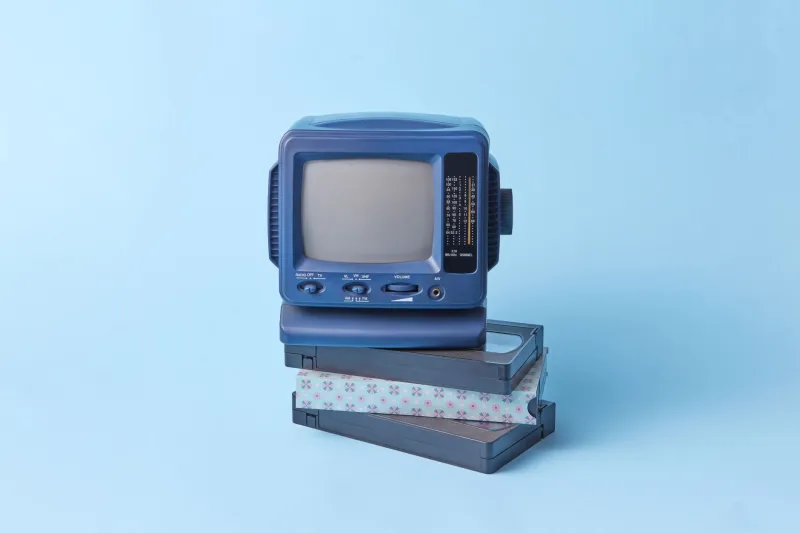
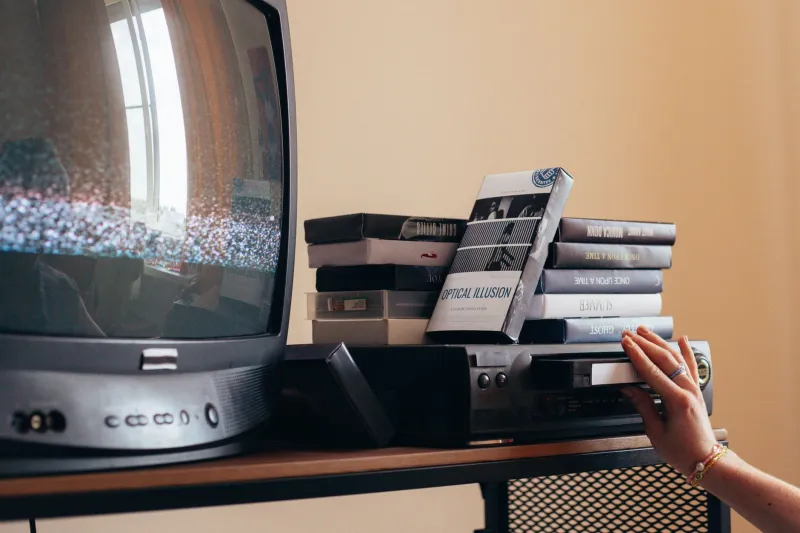
Somewhere in a climate-controlled storage unit outside Akron, Ohio, there are seventeen VHS tapes that—according to the people who've studied them—document the interior of a shopping mall that was never built. The footage is mundane in the way that makes it unsettling: fluorescent lights humming over empty storefronts, a food court with chairs stacked on tables, corridors that stretch just a little longer than architecture typically allows. The mall, based on signage visible in certain frames, appears to be located in suburban New Jersey. No such mall exists. No permits, no groundbreaking ceremony, no news coverage. Just the footage.
The tapes belong to a collector who goes by the handle MallRat_Null in the online communities where this kind of material gets discussed, traded, and obsessed over. He found them at an estate sale in 2019 and spent two years trying to match the location to anything on record before concluding—tentatively, reluctantly—that he couldn't.
"I'm not saying it's paranormal," he told us over a voice call. "I'm saying it's unaccounted for. Those are different things. But the gap between them is where it gets interesting."
The Community That Grew Up Around the Gap
MallRat_Null isn't alone. Over the past several years, a diffuse network of video archivists, analog media enthusiasts, and what some members call "temporal anomaly researchers" has coalesced around a shared fixation: footage that doesn't fit the historical record. They operate across private Discord servers, niche subreddits, and a handful of independent websites that look like they were designed in 2003 on purpose.
The material they collect falls into a few loose categories. There's anachronistic home video—footage that appears to have been shot on consumer camcorders before consumer camcorders existed, showing domestic scenes from the 1950s and '60s with the grain structure and aspect ratios of formats that wouldn't be developed until decades later. There's phantom surveillance, tapes purportedly from security systems installed in locations with no documented history of surveillance equipment. And there's a stranger category that members call event footage, which is exactly what it sounds like: recordings of things that, by all available evidence, were never filmed.
Skepticism is reasonable here, and the community knows it. Misidentification is common. Old footage gets misdated constantly—archival conditions, tape degradation, and sloppy labeling can make a 1987 recording look decades older than it is. Deepfakes and digital manipulation have become sophisticated enough to fool casual viewers. And hoaxing, in these circles, carries a certain cultural cachet. Fabricating a convincing "impossible" tape and releasing it into the collector ecosystem is, for some people, its own art form.
Where It Gets Harder to Dismiss
But then there are the cases that don't resolve cleanly.
A researcher in the Pacific Northwest—she asks to be identified only as Vera—has spent four years investigating a collection of 16mm film reels that surfaced at a Portland estate sale. The reels appear to document a political rally in what looks like downtown Seattle, circa late 1940s. Standard stuff, except the speaker at the podium is a man whom historical records indicate died in 1943, and the crowd includes at least three individuals Vera has cross-referenced with obituaries predating the apparent filming date.
"The easy answer is that I'm wrong about the date," she says. "But the film stock has been independently tested twice. The emulsion composition is consistent with the manufacturing window I've identified. I've had two labs look at it. Neither one could tell me I was wrong."
Vera is careful not to overstate her conclusions. She doesn't use words like "impossible." She uses words like "unexplained" and "inconsistent" and occasionally, in a lower register, "weird as hell."
The 16mm reels sit in a fireproof cabinet in her apartment. She's made digital transfers, shared them with the community, and invited scrutiny. So far, no one has produced a debunking that fully accounts for the physical evidence of the film stock itself.
The Methodology (Such As It Is)
What's notable about the more serious members of this community is how much effort they put into trying to disprove their own findings. There's a shared document—updated collaboratively, running to several hundred pages—that outlines authentication protocols: how to properly date film stocks and magnetic tape formulations, how to identify digital manipulation artifacts, how to cross-reference location details against historical records and permit databases.
It reads like something between an academic paper and a field guide for a hobby nobody has a name for yet.
"The goal isn't to prove the footage is impossible," says a member who goes by Crestwood_Felix and works, in his non-archivist life, as a data analyst in Chicago. "The goal is to eliminate every possible mundane explanation and see what's left. Sometimes what's left is nothing—you figure out the tape is misdated and you move on. But sometimes what's left is a question you can't answer, and that's the part we're interested in."
Crestwood_Felix has catalogued over forty pieces of footage he considers "unresolved." He estimates that roughly a third of the material that comes through community channels turns out to be hoaxes or misidentification. Another third gets resolved through conventional research. The final third—the cases that resist explanation—is what keeps him up at night.
The Hoax Problem (And Why It Doesn't Quite Explain Everything)
Let's be honest about the hoax thing, because it matters. Several high-profile pieces of footage in these communities have been definitively exposed as fabrications—sometimes by the people who made them, sometimes by forensic analysis. The community's own debunking track record is actually pretty solid. They've caught deepfakes, they've identified incorrectly labeled archival footage, they've called out deliberate misdating.
Which is part of what makes the remaining cases feel different to the people studying them. The hoaxers, paradoxically, have raised the bar. When something survives sustained scrutiny from a community that's actively looking for the trick, the lack of a trick becomes notable.
"Anyone can make a fake tape," MallRat_Null says. "It's actually not that hard if you know what you're doing. What's hard is making a fake tape that survives four years of people trying to catch you. At some point you have to ask—if it's a hoax, what's the long game?"
Signal and Static
Nobody in this community is making clean claims about what any of this means. That's actually one of the more interesting things about it. There's no unified theory of where the footage comes from, no consensus cosmology of phantom recordings. Some members lean toward mundane explanations they just haven't found yet. Others entertain stranger possibilities—misrouted data, recording artifacts that preserve something they shouldn't, questions about the nature of documentation itself that get philosophical fast.
What they share is the footage, and the attention they bring to it, and the refusal to look away from the parts that don't resolve.
The Akron storage unit still holds those seventeen tapes of the mall that wasn't. MallRat_Null has no plans to sell them. He's still looking for the mall.
"Maybe I'll find it eventually," he says. "Maybe someone will watch the footage and recognize a tile pattern or a storefront font and say, yeah, that's Route 9, that's 1994, here's the permit. I'd be relieved. I genuinely would."
He pauses.
"But I've been looking for five years. And the mall isn't there."